


We nearly always make time for a visit to the Puces de Saint-Ouen when we’re in Paris. But even as veteran treasure hunters, we still find the five-acre sprawling flea and antiques market at the northern gates of Paris to be completely overwhelming. So we were excited to crack open The Paris Flea Market, a coffee-table-size book by Kate van den Boogert, the Australia-born, Paris-based vintage expert who hosts private half-day and full-day tours and has relationships with some of the market’s best vendors. (Everyone from Simon Porte Jacquemus and interior designer Jacques Grange to Ina Garten are fans.) In it, she draws back the curtain on the nearly impenetrable world of the Puces, presenting several dealers at its heart – colorful characters and collectors who are wildly obsessive about their stylistic niche, be it 18th-century furniture or post-war ceramics. We also asked her for hacks for navigating the different markets, negotiating tips, and where to refuel with coffee, lunch, or apéro.
By Alex Postman | Read the full article/ interview here.

Tell us a bit about why you became fascinated with the Parisian flea market.
The Puces fascinated me because it felt like a city within a city: sprawling, eccentric, deeply human and surprisingly difficult to understand from the outside. The more time I spent there, the more I realized it wasn’t simply a place to buy things. It’s a literal ecosystem of expertise, taste, history and commerce populated by remarkable characters whose knowledge has often been built over decades. What began as curiosity became an obsession.
What’s so special about the place?
For me, the markets are part museum, part escape, part social theatre. It’s like disappearing into a little village on the edge of Paris, with its own rhythms, characters and codes – a spirit that still feels connected to the old popular Paris of ragpickers and Les Halles.
What did you learn about the Puces of St Ouen during your research for your book that surprised you most?
I remember discovering old photographs of “La Zone”– the informal settlement that grew up outside Paris’s fortifications in the mid 19th century, and where many chiffonniers, or ragpickers, lived. I first encountered them in an exhibition by the gallery Lumière des Roses at the Rencontres d’Arles photography festival in 2019. Those images completely changed my understanding of the Puces. They revealed that behind today’s world-famous antiques market lies a much rougher, more marginal and deeply human history.


I was also struck by a passage in Victor Hugo’s Les Misérables (1862), where the chiffonnier Vargouleme describes his daily sorting. It brings this lost métier vividly to life, and in many ways feels like an origin story of the Puces: “In the morning, on my return home, I pick over my basket, I sort my things. This makes heaps in my room. I put the rags in a basket, the cores and stalks in a bucket, the linen in my cupboard, the woollen stuff in my commode, the old papers in the corner of the window, the things that are good to eat in my bowl, the bits of glass in my fireplace, the old shoes behind my door, and the bones under my bed.”
You use a word to refer to the French art of browsing, chiner – can you unpack that meaning for us?
Chiner is the French verb for browsing or hunting for second-hand objects, but it’s a word that doesn’t really translate. It’s not quite antiquing, bargain hunting or treasure hunting. You can’t chiner new things. It describes a very specific way of moving through the world of objects: browsing without necessarily knowing what you’re looking for, guided as much by intuition as by intention. It’s less a transaction than a process – almost a state of mind. The Surrealists loved the Puces for exactly this reason – André Breton and Giacometti came here searching for those strange moments of “objective chance”, where an unexpected object seems to speak directly to the unconscious.
With many different markets sprawling over a huge footprint, it can feel overwhelming for a traveler to get off the metro at Porte de Clignancourt and know where to start. What’s your advice?
Rather than thinking of it as a single flea market, it helps to see the Puces as a village in its own right – made up of different quarters, each with its own history, rhythm, and specialist language. It really is a place with its own culture, almost its own set of rules. So my advice is simply to slow down. Don’t try to “do” it in one go, and don’t worry about orientation at first. Start with curiosity rather than strategy. You inevitably get lost – but that’s part of the experience. I sometimes joke that I feel like I need my passport when I go, because you really are crossing into another world.


How did you choose the vendors you featured in the book and what are some common traits?
The book is not a guide or a “best of” the Puces. It is a curated sample – a small chorus of 23 voices (including a handful of creative professionals) that, together, suggest something of the spirit of the place. The Puces is vast, with thousands of dealers, and what I wanted was to capture a sense of its diversity rather than attempt to summarize it. But there are thousands of dealers there, and I continue to publish portraits of them on my Substack because the place is never fully captured. It keeps evolving, and you can only ever approach it through fragments.
Can you pick three?
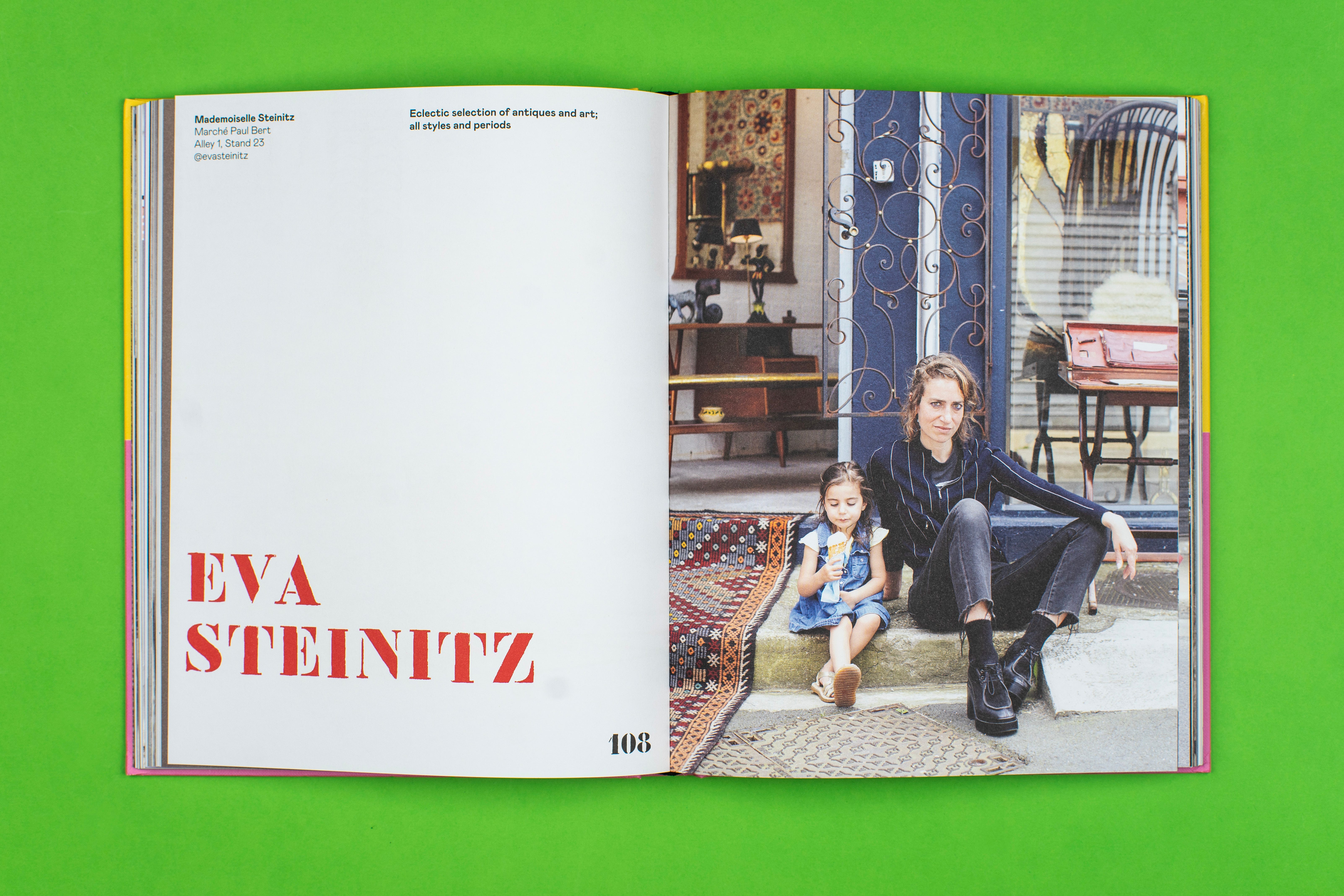
Ok, if you insist! Eva Steinitz is the granddaughter of famed antiques dealer Bernard Steinitz, who had a gallery on Faubourg Saint-Honoré – so she’s Puces aristocracy in a way. Her taste is bold and creative and looks to go beyond “good taste,” which I find so inspiring. She says, “It depresses me to try to have ‘good taste,’ I don’t like the feeling of superiority. I don’t want to be obsessed with pleasing, with corresponding either to fashion, the diktats of the market, or to an idea of beauty; I prefer charm, to speak to muted sensitivities, and arouse curiosities, ways of seeing that are not predictable.”
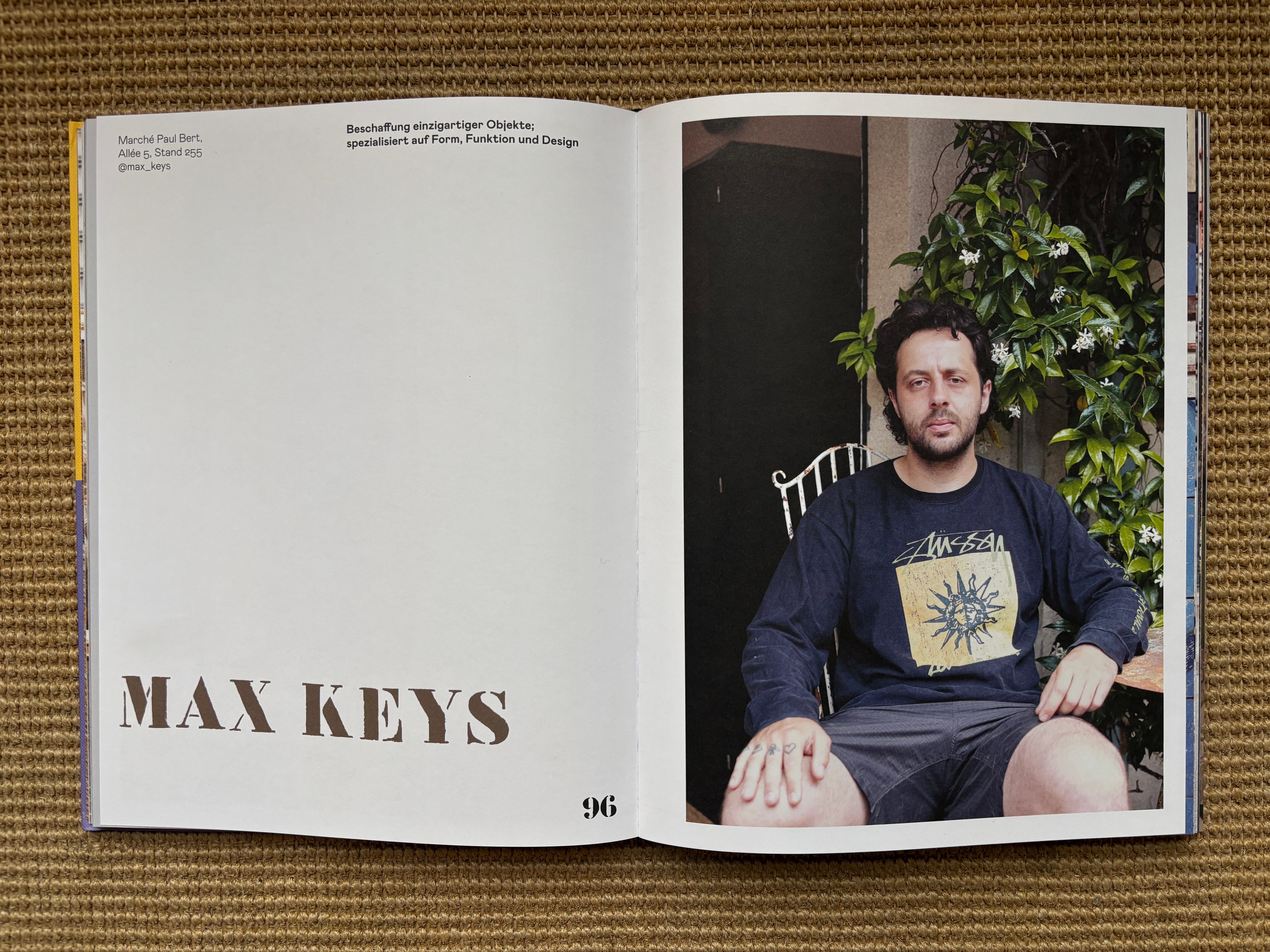
Max Keys, originally from London, has a great and eclectic eye, sourcing just as many fabulous anonymous pieces as ones with a signature, or documented provenance. He’s a great ensemblier, inspired by the idiosyncratic taste of Jacques Grange, David Hicks and Christopher Hodsoll. To quote him: “I have a pretty quirky style. I have always found strength in individual pieces, rather than focusing on a certain period or style. I predominantly buy 20th century pieces, but I would gladly buy Renaissance if it had something going for it. I recently sold a Byzantine gold necklace and in the same day bought the most amazing Deco chairs. I’m more interested in items than names and I think the item has to really speak, has to make an immediate statement.”
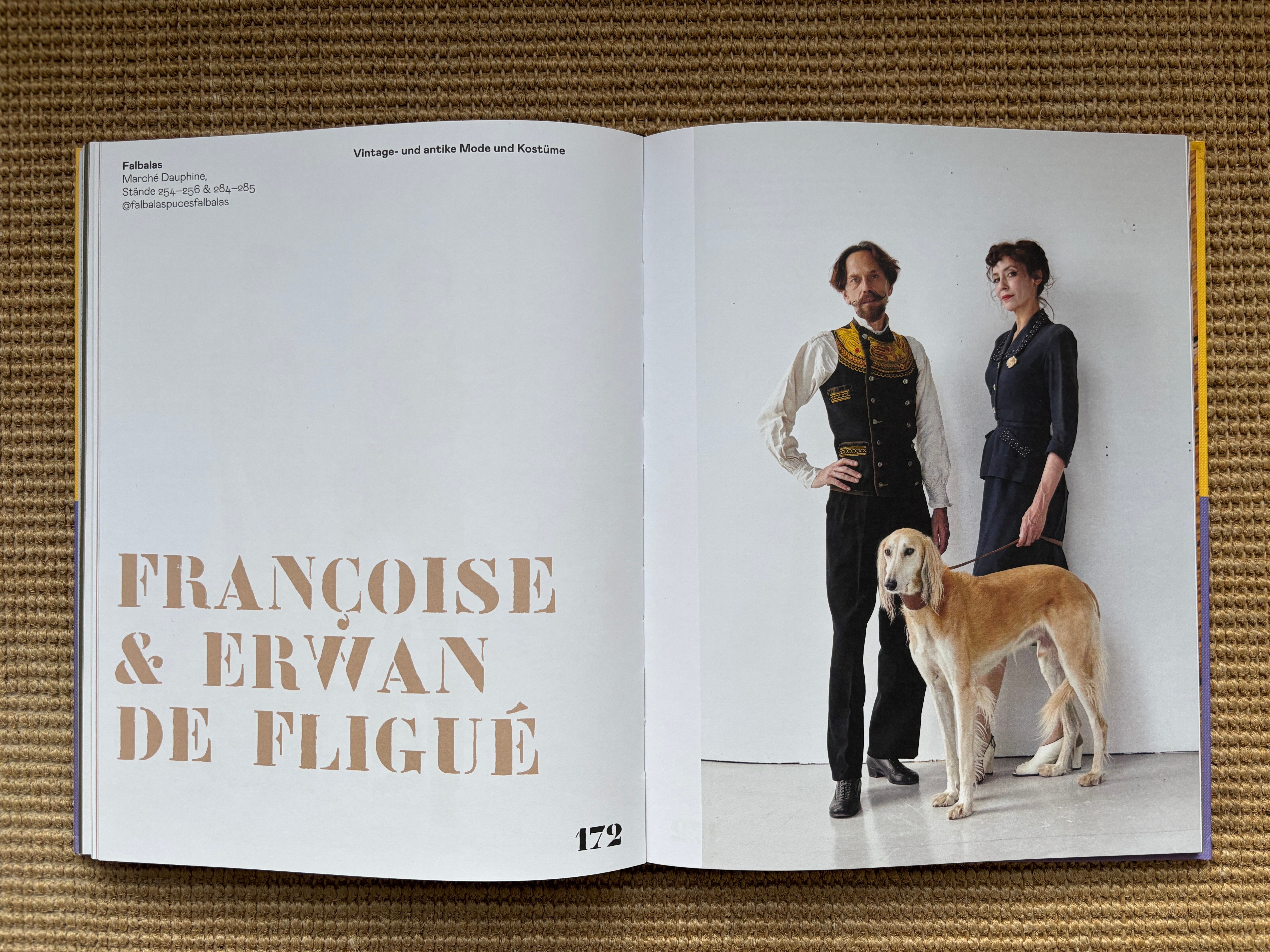
And the flamboyant Erwan de Fligué of Falbalas is a brilliant fashion historian and recognized expert who consults for many of the fashion museums here. His knowledge is vast and he’s great to listen to, but also to look at! He only dresses in period costume from between 1880 and 1939 and takes his role as a second-hand dealer very seriously: “When I go hunting for pieces, and I spot, on top of a pile of crap, an old piece that no one else has spotted, I feel like I’ve saved something, and that it will be of use to someone else. This is really important for me. In fact, it’s political…. I would like most of the things that are older than me to survive me. It’s not about objects that pass by and that I consume. I consider myself to be simply a custodian.”
I love this idea that you write about, that exploring the market is both a time capsule and a sort of subversive sensory and aesthetic experience…
Yes, that’s very much how it feels. The Puces is full of layers of time – nothing is linear there, every period coexists. It’s like a time machine moving through the history of civilizations, from Ancient Rome to Art Deco, the Middle Ages to Mid-Century Modern, the Renaissance to Memphis Milano. At the same time, it is a very immediate, physical experience. You’re constantly moving between eras, styles and values, but also between instinct and analysis. That tension is what makes it so compelling.
Do you have favorite vendors that you always return to again and again, and for what?
Over time you build affinities, both aesthetic and personal. And more than finding things to buy, it’s the rich human tapestry there that I love to engage with. I’m constantly meeting new people and making new friends there.
A few of the dealers I’ve only got to know since my book came out and who I love include: Mei Mei @meimei_vintage, a working model and a music, fashion and animal-lover (check her Instagram to meet her pet cockatoos) and the owner of a vintage fashion stand in the Marché Vernaison. Love her fashion inspo! Last Sunday she was wearing a ‘70s leather jacket and dress, a t-shirt she bought at a Chemical Romance concert accessorized with a Basque beret and shoes from UK brand Body Amplification Devices.


Over at the Marché Paul-Bert, Christophe Guérard (@anti_matiere_interieur_) and Manolo Vosse (@galeriekopek)share a very personal, almost poetic approach to the antiques business – one that values the secret histories and intrinsic formal power of objects over their market price. Another young dealer is James Darle of @darlemalotaux who curates bold, unexpected, fun and cool displays on his stand: a 1970’s B&B Italia sofa by Afra & Tobia Scarpa next to a pair of Swedish monk chairs from the 1930s, a Spanish cabinet from the early 17th-century and a ceramic vase by Ulrica Hydman-Vallien for Kosta Boda from the ’90s.
Practicalities: Best day to go? Is it okay to bargain? Do most vendors ship? Is it better to pay in cash?
It’s really only open at full capacity on the weekend, so that’s the best time to go. Yes, bargaining is absolutely part of the experience, and visitors are quickly given a masterclass in haggling! Shipping can generally be arranged for a price, and on the surface it can appear relatively straightforward. In practice, there are subtleties that come into play depending on the type and volume of pieces, as well as the destination. Over time, one learns how to optimize that process quite carefully. Cash is still useful, and some dealers only work in cash, although most now accept cards. There are only a few ATMs at the Puces, and they can have long queues, so it’s better to come prepared.
What are some of your best scores over the years?
Honestly, I don’t really go to the Puces to shop anymore – my tiny Paris apartment is already bursting at the seams! But humble little treasures do occasionally follow me home: an old Indian glass painting of a butter-stealing Krishna, a carved lion’s paw from a forgotten piece of furniture, a beautiful old silk scarf probably from a Lyon workshop, the broken marble hand of what may have been Apollo, pulled from the bottom of the Mediterranean for a dealer friend, or a tiny fragment of Byzantine mosaic picked up for a handful of coins.
Read the full article/ interview here.
👉🏽 After years exploring the Puces de Saint-Ouen and researching for my book ‘The Paris Flea Market’, I now share that insider knowledge through bespoke buying and research tours – for collectors, decorators, architects, or anyone who wants to explore the place with a deeper eye. Hit me up!